

Subcontracting Contract in France: Clauses and Rules
Subcontracting contract in France: definition, the 1975 law, clauses to include, payment terms and how it differs from a service contract. A freelancer guide.
Blog
Wage portage and simulation
Explore how it works and estimate your net income in a few clicks.
Pick a tool: it opens in a new tab with a prompt ready to summarize this page.
Karim works as an IT consultant. Eight months into wage portage with a French umbrella company, he gets an email from his client fixing his hours down to the quarter-hour, demanding he show up on-site five days a week, and approving every task before he's allowed to start it. He starts wondering whether his client has quietly become his real employer.
Legal subordination is the power an employer holds to give orders to a worker, check how those orders get carried out, and punish anyone who doesn't comply. Its absence is the legal condition that lets a freelancer, a sole trader, or a wage-ported consultant stay independent from their client instead of sliding into disguised employment.
Since a landmark 2001 ruling, France's top court has used one clear test: subordination exists when someone gives orders and instructions, checks how they're carried out, and punishes failures to comply. Labor inspectors, URSSAF auditors, and labor courts all reach for this same three-part grid when they review a contract.
No single criterion settles the matter on its own. Judges weigh a bundle of clues: imposed hours, tools supplied by the client, integration into a team, and whether the worker has other clients at all. A freelancer who bills per deliverable, sets their own hours, and keeps several clients on the books has a strong case for staying outside this zone.
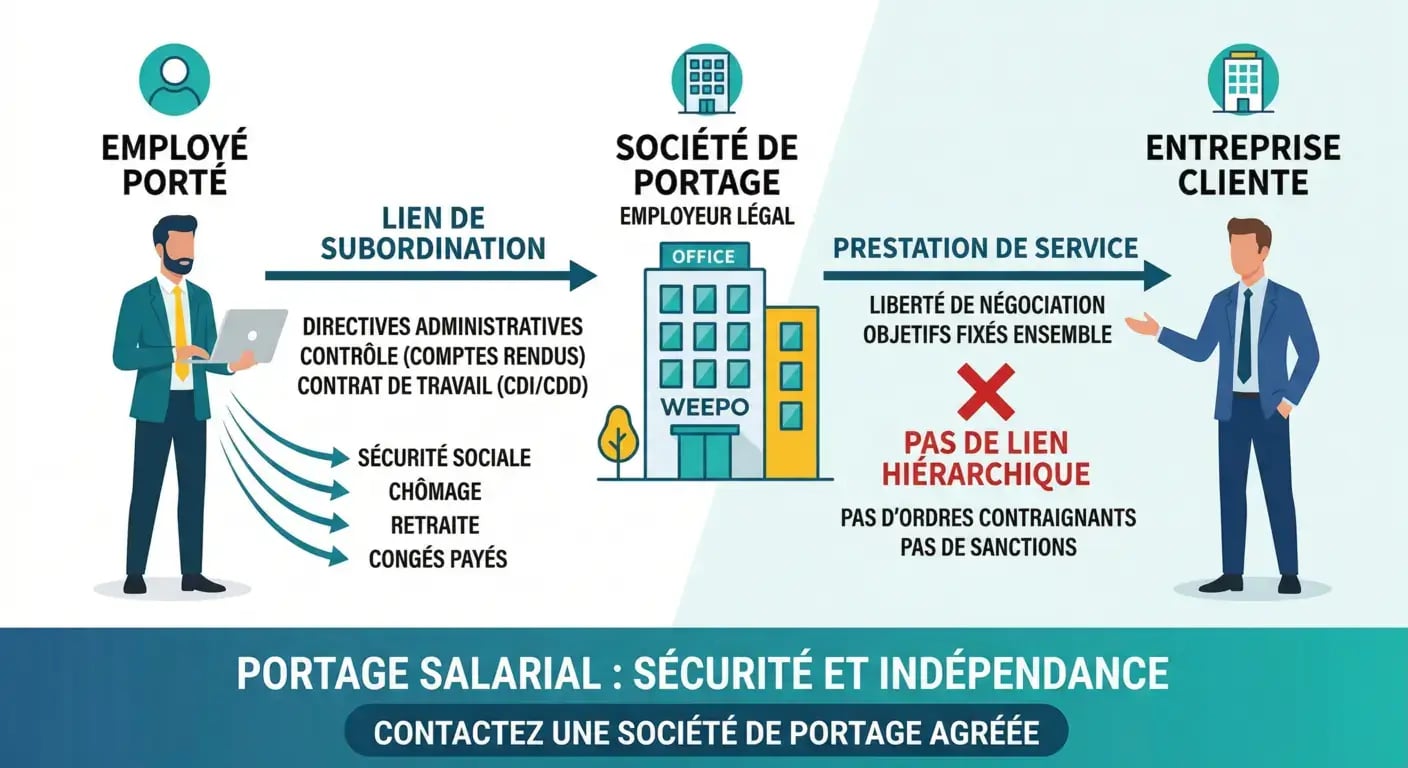
In wage portage, subordination does exist, just not toward the end client: it links the consultant to the umbrella company, which pays their salary and handles their social contributions. The client has no hierarchical authority over the consultant at all. They're buying a service, not subordinate working hours.
This three-way setup (consultant, umbrella company, client) solves most of the problem that classic freelancers and sole traders run into. Without an umbrella company standing between them and their client, they have to prove, mission after mission, that they still control how they work. Whichever professional status they pick doesn't erase that risk, it just moves it somewhere else in the contract. The rules behind that choice are laid out on the legal status page for wage portage.
Weepo structures every wage portage assignment so that line stays clear: a portage agreement with the consultant, a commercial contract with the client, and no direct subordination between the latter two.
A company that dictates a contractor's hours, tools, and reporting line risks having that contract reclassified as an employment contract, with back-paid social contributions and criminal penalties for undeclared work. The worker, for their part, can take the case to a labor court and claim an employee's rights retroactively: paid leave, severance pay, protection against dismissal.
This isn't a theoretical risk. According to URSSAF's annual report, published in February 2026, corrections for undeclared work hit a record 1.5 billion euros over 2025. Part of that figure covers sham subcontracting treated as disguised employment: independent workers managed, in practice, exactly like employees, without the status or the protections that come with it.
For the client company, the bill runs well past the back-paid contributions: penalties, late interest, and sometimes exclusion from public contracts. For the worker, reclassification usually arrives too late, after a contract ends in a way that feels like a dismissal without any of the safeguards attached to one.
A freelancer lowers reclassification risk by keeping control of their own organization: flexible hours, their own tools, billing per deliverable, and several active clients at once. Each of those details weighs into the bundle of clues an auditor reviews.
A few concrete habits change the picture. Push back on an hour-by-hour imposed schedule. Negotiate flat-fee billing over hourly billing wherever that's realistic. Keep written traces of exchanges that show real autonomy over working methods. Avoid, as much as possible, putting 100% of your activity with a single client over a long stretch.
Wage portage remains the most direct way to get an employee's security without giving up a freelancer's autonomy. A ported consultant can simulate their net salary under wage portage before signing a first assignment, to see exactly what that protection costs and brings in return.
| Criterion | Standard employee | Independent freelancer | Wage-ported consultant |
|---|---|---|---|
| Hours set by the client | Yes | No | No |
| Client's power to sanction | Yes | No | No |
| Social contributions paid by | The employer | The freelancer | The umbrella company |
| Unemployment protection | Yes | No | Depending on eligibility |
| Number of possible clients | One employer | Several | Several |
Per France's digital labor code, this test applies no matter what a contract calls itself: labeling it a « service agreement » doesn't protect a company if, in practice, subordination exists. Official texts on Légifrance also note that Article L8221-6 of the French labor code sets a presumption against employee status for properly registered independents, a presumption that can still be overturned if the facts say otherwise.
It means the contractor stays free to organize their own work, hours, and methods, without taking orders from the client on how to do the job. It protects the client company from reclassification risk, as long as day-to-day reality backs up that independence.
No. A ported consultant's subordination link sits with their umbrella company, which pays their salary. The relationship with the client stays commercial: it's about a mission and a deliverable, never about direct hierarchical authority.
Giving orders and instructions, checking they're carried out, and sanctioning failures to comply. Together, these three powers legally define subordination, whatever label the contract carries.
In practice, a client can ask for availability during certain windows for operational reasons. But once those hours turn into a strict, daily-monitored obligation, the way they would for an employee, reclassification risk climbs sharply.
Document the exchanges, push back on instructions that go beyond the contract's scope, and talk to an employment law specialist or an umbrella company to secure the mission before a dispute or an audit breaks out.
Author

Responsable Marketing & Communication chez Weepo, je suis passionnée par l'animation du réseau et l'accompagnement de nos consultants. J'organise des événements parisiens et accompagne nos équipes régionales pour créer des moments d'échange enrichissants dans l'écosystème du portage salarial.
More
Subcontracting contract in France: definition, the 1975 law, clauses to include, payment terms and how it differs from a service contract. A freelancer guide.

Versement libératoire 2026: eligibility, 1% to 2.2% rates and maths. Compare it with standard income tax through two worked examples before the deadline.

What is the DPAE? Learn who files it in wage portage, when to send it, what you risk without it and what to check before your first consulting mission starts.