

Mutual Termination in Wage Portage: The 2026 Guide
Mutual termination in wage portage: eligibility conditions, step-by-step process, compensation calculation, and impact on your unemployment benefits in 2026.
Blog
Wage portage and simulation
Explore how it works and estimate your net income in a few clicks.
Pick a tool: it opens in a new tab with a prompt ready to summarize this page.
Key takeaways:
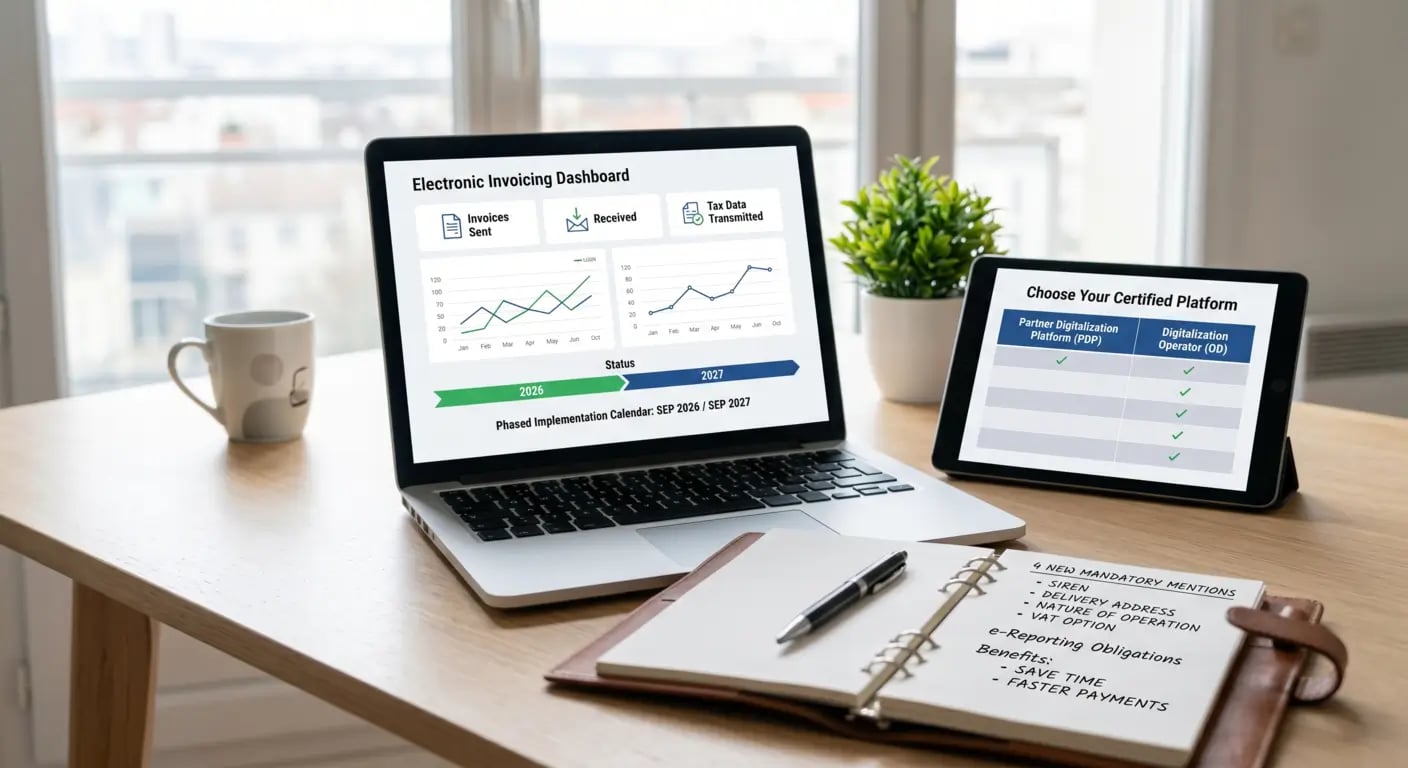
Want to know the impacts of electronic invoicing for self-employed workers? Mandatory for all entrepreneurs from 2027 onward, this is a digital invoicing process aimed at modernizing administration and fighting tax fraud. This new invoicing method disrupts the accounting of microenterprises. That's why Weepo details the real impacts of the reform on your activity: from choosing a certified platform to possible sanctions, as well as issuing the electronic invoice.
According to article 91 of the 2024 finance law, the phased implementation calendar for electronic invoicing is as follows:
There are two types of certified platforms that allow you to issue your electronic invoices:
If you choose a partner digitalization platform, make sure to perform the following checks:
| Check to perform | Explanation |
| Verify the PDP’s registration with the tax administration and its certification | Make sure the partner digitalization platform is registered with the tax administration and certified by a supervisory authority to guarantee its compliance with legal frameworks. |
| Analyze the functionalities offered by the platform | Check that the options offered really meet the needs of a self-employed worker; for example, the management of invoice formats and legal mentions specific to the microenterprise scheme. |
| Check the supported electronic invoice formats | Make sure the platform supports the formats required for your business (EDI, XML, signed PDF, Factur-X, UBL, UN/CEFACT CII) to ensure compatibility with your clients and partners. |
| Control guarantees of data confidentiality during exchanges | Verify that the platform guarantees data security and confidentiality during exchanges, in particular when sending electronic invoices via secure protocols such as EDI. |
💡Did you know? : To support this transition, the DGFIP has published a list of the first 101 certified platforms that enable you to issue and receive electronic invoices compliant with legal requirements. Check this link to learn more: Switch to electronic invoicing | impots.gouv.fr.
Until now, all invoices, electronic or not, must be written in French, issued in two copies, and include a set of mandatory mentions. However, as of July 1, 2027, four new mandatory mentions must appear on your invoices:
Your electronic invoices must be issued directly from your chosen platform, either by providing the required data (customer information, your SIRET number, etc.) or by uploading a PDF invoice for automatic pre-filling of the relevant fields. The platform then takes over to structure the invoice in electronic format, extract and transmit the data and transactions to the tax authorities.
Electronic invoicing now requires you to comply with e-reporting, i.e., transmitting all data related to your commercial transactions to the tax authorities. This obligation concerns sales to individuals and international transactions (intra-community deliveries, exports, etc.). The aim for the tax authorities is to reconstruct companies' economic activity and real revenue.
Electronic invoicing also brings several benefits to your self-employed business:
| Advantage | Consequences |
| Simplified invoicing | - Around 30% less processing time - Less manual entry |
| Reduced processing costs | - An electronic invoice costs about €0.40–€0.45 - A paper invoice can exceed €10 |
| Faster payments | - Reduced payment times - Automatic reminders, fewer delays |
| Easier VAT declaration | - Pre-filled declarations (if liable) - Reduced administrative time |
| Secure transactions | - Protected data exchanges |
| Invoice compliance | - Legal mentions respected - Fewer errors or omissions |
| Better traceability | - Easier filing and archiving |
| Simplified communication with the authorities | - Easier data transmission to the tax administration |
| Smoother B2B relations | - Better invoice tracking
- Easier communication with partners |
If you do not use a certified platform to issue your invoices, you risk financial penalties up to €500 or €1,000 as well as losing the right to deduct VAT from your purchases and to receive valid invoices from your suppliers. As for not performing e-reporting, this can be penalized up to €250 per invoice.
💡Good to know: this reform easily detects irregularities and missing required mentions on invoices, which greatly exposes companies to sanctions for failing to comply with the LME ("Loi de modernisation de l'économie").
You now know the impacts of electronic invoicing on self-employed workers. Let's sum them up:
Additionally, see our article on how to correctly draft your freelance invoice.
Author

Responsable Marketing & Communication chez Weepo, je suis passionnée par l'animation du réseau et l'accompagnement de nos consultants. J'organise des événements parisiens et accompagne nos équipes régionales pour créer des moments d'échange enrichissants dans l'écosystème du portage salarial.
More
Mutual termination in wage portage: eligibility conditions, step-by-step process, compensation calculation, and impact on your unemployment benefits in 2026.

How do you convert gross to net pay for a French cadre? The 2026 formula, worked examples, official scale, and a simulator for wage portage freelancers.

Freelance accountant in 2026: real rates, a full comparison of every option, and exactly how to choose. Discover the wage portage alternative with Weepo.