

Going Freelance in France in 2026: Which Status to Pick?
Going freelance in France in 2026: micro-entreprise, SASU, EURL or wage portage? Compare statuses, steps and costs, then simulate your net pay in 2 minutes.
Blog
Wage portage and simulation
Explore how it works and estimate your net income in a few clicks.
Pick a tool: it opens in a new tab with a prompt ready to summarize this page.
Article summary:
Wondering how to ensure good freelance organization? Being a freelancer is synonymous with freedom and independence, but between meeting deadlines, client meetings, and admin tasks, this status requires a structured approach. That's why Weepo shares all the tips you need to manage your freelance business. From your workspace to commercial management and optimizing work methods, you will now know how to organize yourself as a freelancer.
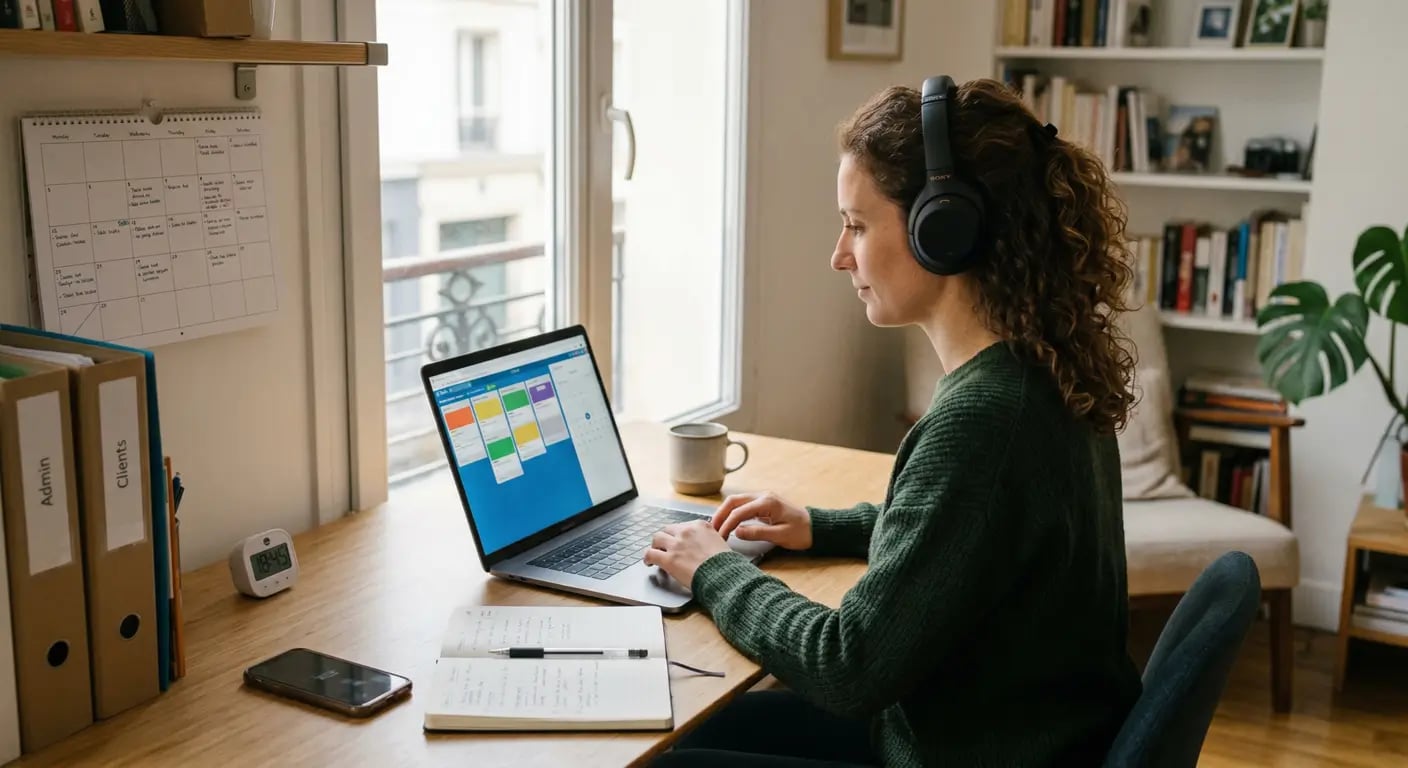
When you're freelancing, choosing a quiet workspace is the first step. Ideally, set up a dedicated office or room for your work and close the door while you finish your tasks. If you don’t have a dedicated room, you can use a divider or curtain as a partition and wear noise-canceling headphones to block out sounds. While working, eliminate all distractions around your workspace. Common distractions include:
Cut off all these distractions and return to them only after completing your main task.
💡Good to know: If it’s hard to set boundaries between work and personal life, consider going to a coworking space to benefit from a productive work environment.
For more clarity as a freelancer, get into the habit of writing down all ideas that come to mind. Always have a notepad nearby—at your desk, in the living room, or kitchen—or use a phone app. Writing things down empties your mind and reduces pressure.
Consider keeping a paper/electronic planner or an online calendar to remember client deadlines, meetings, video calls, etc. A planner or calendar helps you plan actions so you never forget anything important.
Comparison Table of Top Planning Tools for Freelancers:
|
Tool |
Main features |
Benefit for freelancers |
|
Trello |
- Boards, lists and visual cards - Checklists and labels - Task assignment and due dates - Integrations (calendar, Slack, etc.) |
- Clear workflow overview - Easy tracking of tasks in progress and upcoming - Ideal for simple project management |
|
Notion |
- Customizable pages (notes, databases) - Templates for projects, CRM, planning - Database linking - Real-time collaboration |
- Centralizes info, tasks, docs - Flexible for structuring your activity - All-in-one (calendar, projects, notes) |
|
Evernote |
- Enhanced note-taking (text, images, PDF) - Tagging for classification - Smart search within notes - Web clipper |
- Efficient organization of ideas and documents - Fast access to information - Perfect for storing meeting notes or client briefs |
|
Google Calendar |
- Shared calendar and events - Notifications and reminders - Integration with Gmail, Google Meet - Colors for event categories |
- Time and appointment management - Easy day planning - Reduced forgetfulness thanks to reminders |
To learn more, check our guide on project management tools.
The 80-20 method, like the Pareto principle, involves focusing your efforts in the right places, namely the 20% that matter most. It’s a strategic approach to improve profitability and avoid getting lost in insignificant details that waste time.
📌Pareto Principle Example:
You can identify times of day when you're most productive. This way, you’ll work fewer hours but be much more effective. Ask yourself: what 20% of the day makes you 80% productive?
It's tempting for freelancers to think multitasking goes faster, but that's not true. On the contrary, no task will be done right if you work that way. Instead, focus on one task at a time and only start a new one after finishing the previous one.
The Pomodoro technique has you alternate between work phases and breaks to set a defined time for each activity. It’s highly effective and will greatly increase your productivity.
📌Pomodoro Technique Example:
For example, work 30 minutes and take a 5-minute break, then repeat as needed until a task is completed. You can use a timer to help you.
Being a freelancer doesn’t always mean you must do everything yourself. You might consider delegating some tasks to focus on your core business and free up your mind.
💡Good to know: If you choose wage portage, you can delegate all your administrative management to an umbrella company. For example, at Weepo, with our triple T slogan "transparency, technology, tranquility", we take care of everything so you can work with peace of mind.
By setting a maximum of 3 tasks to complete in a day, you avoid a never-ending to-do list, prevent spreading yourself too thin, and actually finish your objectives. Set your three tasks the night before or in the morning, and schedule them in your calendar or planner.
Always be diligent with your invoicing:
These four obligations should become second nature to avoid disputes with your clients, unpaid invoices, or trouble in the event of an URSSAF audit.
Also, be punctual with your filings by respecting all admin deadlines according to your business structure and legal status. This includes declaring your turnover, VAT, and CFE…
💡Good to know: As with your projects, remember to schedule admin tasks in your project management tool.
To properly structure your freelance activity, you need excellent client relationship management. Use best practices to build client loyalty and increase your chances of long-term collaborations. It's key to your business longevity. Some best practices:
As a freelancer, you often face loneliness and isolation, which can impact your motivation and productivity. Sometimes, you may not know how to structure your activity. That’s why connecting with other independents is helpful to exchange tips and discover new opportunities. Consider attending afterwork events, joining a freelance collective, or interacting on social networks.
💡Good to know: If you are in wage portage, you can join the umbrella company Weepo and get personalized support with a responsive team at every stage of your project.
You now know how to maintain a structured and efficient freelance organization. Remember these key points:
For further reading, check out our guide entrepreneurship alone.
Starting as a freelancer can be tricky, especially when you run into common pitfalls like undercharging, writing invoices, lack of contracts or clear proposals, or simply a lack of organization.
The first step is to leave your job or free up your schedule so you can focus on your new activity. Then, it's essential to start your business and lay solid foundations for your launch. Finally, find your first client and gradually develop your professional network to sustain your freelance activity.
Author

Responsable Marketing & Communication chez Weepo, je suis passionnée par l'animation du réseau et l'accompagnement de nos consultants. J'organise des événements parisiens et accompagne nos équipes régionales pour créer des moments d'échange enrichissants dans l'écosystème du portage salarial.
More
Going freelance in France in 2026: micro-entreprise, SASU, EURL or wage portage? Compare statuses, steps and costs, then simulate your net pay in 2 minutes.

Cipav pension explained: who is affiliated, what you pay in 2026 (10.10% basic rate) and when you can retire. IT consultants, check your scheme below.

How to find freelance missions in IT? Five channels that work, a day-rate calculation and how wage portage can secure your next client without extra paperwork.