

SNC (General Partnership): Definition and Status 2026
What is an SNC (French general partnership)? Discover its definition, how it works, taxation rules, setup steps, and the best alternatives in France in 2026.
Blog
Wage portage and simulation
Explore how it works and estimate your net income in a few clicks.
Related guides
Pick a tool: it opens in a new tab with a prompt ready to summarize this page.
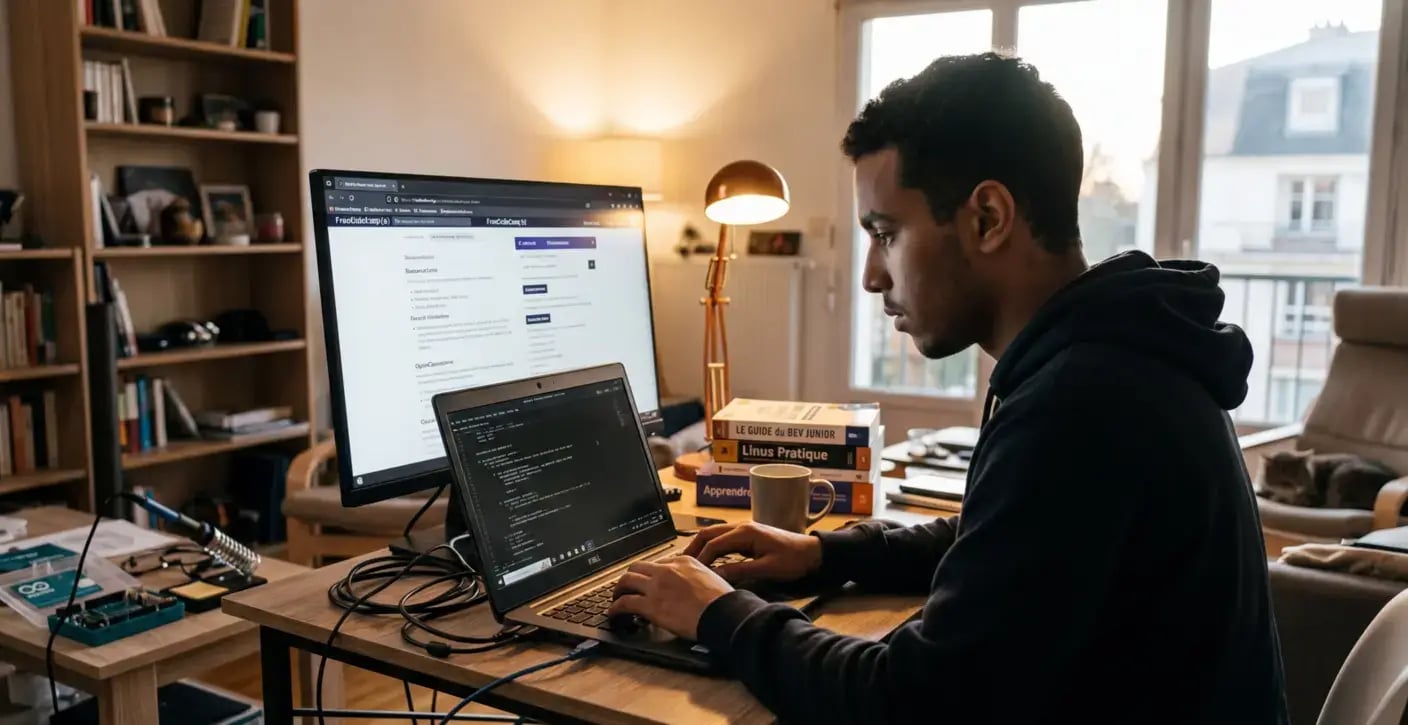
Are you considering becoming an IT specialist without a degree? The digital professions, which are booming, offer countless opportunities for self-taught individuals willing to learn and innovate. That's why, at Weepo, we have prepared this complete guide for you on learning computer science without a degree: from the key steps to enhance your profile for the tech job market, to training programs without a high school diploma, and an overview of the IT jobs accessible without a degree.
To become a self-taught IT specialist, invest yourself in each of the following 6 steps:
💡 Good to know: If you successfully complete your training, you can be recommended to partner companies that are hiring.
Among IT jobs accessible without a degree, you can consider:
| Job | Why it's possible with no degree |
| IT troubleshooting / Customer service | This job is accessible if you know how to solve common IT issues. You need to be able to quickly identify the source of a failure. Solid IT basics and a good method are often enough. |
| Web or mobile developer | No diploma required if you have already created a functioning website or app. Recruiters mainly look at projects delivered. A portfolio is often more important than a diploma. |
| Cybersecurity expert | This field values practical skills. Self-training and practice are essential. Challenges, security tests, and real experiences make the difference. |
| PC assembler | This job is based on technical know-how. You need to know the components and how to assemble them correctly. Experience and meticulousness are more important than a degree. |
| IT support technician | Very similar to troubleshooting. The essential requirement is knowing how to help users and solve simple problems. Practical skills and interpersonal abilities matter a lot. |
| Junior systems administrator | Accessible by starting with small infrastructures. Self-training and home labs are often enough to get started. |
| Tester / QA | You need to be able to spot bugs and follow test scenarios. Precision and hands-on experience are more important than a degree. |
💡 Good to know: If you wish, you can read our article to learn how to become a web developer through wage portage. With the wage portage solution, you can start an activity in IT by delegating all your administrative management to an umbrella company, allowing you to stay focused on your core job.
The profiles and skills sought by companies in IT specialists without diplomas are mainly:
If mastered, these skills often compensate for the lack of a diploma and are highly valued by employers.
💡 Good to know: these IT jobs are also accessible as a self-employed professional. Check out our guide on the conditions to become self-employed without a diploma to start your activity legally.
Alternative programs to traditional academic paths or training programs without a high school diploma offer a pragmatic solution for starting a career in IT. This is the case with distance learning, which allows you to take courses at your own pace and without geographical constraints. These are generally open to a wide audience and allow you to earn a recognized diploma on the job market.
| School / Program | Program content | Outlets / Targeted jobs |
| Ecole 42 | Intensive development training based on peer-to-peer, with no traditional courses or teachers. Learning is done through concrete projects and autonomy. | Software developer, web developer, IT engineer |
| WebForce3 | Short, professional training in web development, data, and cybersecurity, practice-oriented and focused on quick employment. | Web developer, web integrator, full-stack developer |
| Samsung Campus | Free programs focused on development, AI, and digital skills, with a strong link to employability. | Junior developer, digital technician, digital professions |
| Simplon | Intensive and inclusive trainings for digital jobs, accessible with no diploma required and highly practice-oriented. | Web developer, systems and networks technician, junior data analyst |
| Le Wagon | Intensive bootcamps in web development, data, and no-code, focused on the completion of real projects. | Web developer, product builder, junior data analyst |
| Web@cadémie | Free web development training for young people without diplomas, with progressive and professional learning. | Junior web developer, web integrator, digital technician |
| Grandes Ecoles du Numérique (GEN) | Labeled courses, open to everyone, with an average duration of 8 months, covering development, cybersecurity, cloud, data, and systems. | Developer, cybersecurity analyst, systems and network administrator |
You now have all the information you need to become an IT specialist without a degree. Here's a recap:
If you enjoyed this article, why not check out our guide to getting started as a cybersecurity freelancer.
Once you start out as an IT freelancer, also consider professional insurance tailored to IT freelance work (RC Pro, cyber risks) to secure your activity from your very first missions.
Author

Responsable Marketing & Communication chez Weepo, je suis passionnée par l'animation du réseau et l'accompagnement de nos consultants. J'organise des événements parisiens et accompagne nos équipes régionales pour créer des moments d'échange enrichissants dans l'écosystème du portage salarial.
More
What is an SNC (French general partnership)? Discover its definition, how it works, taxation rules, setup steps, and the best alternatives in France in 2026.

Misuse of company assets in a French SASU or EURL: legal definition, the three conditions, 2026 penalties and practical tips to keep your company risk-free.

Slasher worker meaning: this multi-activity profile explained, the French rules for combining jobs, and how wage portage secures your freelance income safely.